Abstract
Anyone that has ever kicked a football knows instinctively that glass breaks and has no place in harsh environments, something of this long held prejudice has been carried through into the relatively new but growing field of optical fiber sensors. After almost 30 years of promise, intrinsic fiber sensors are beginning to realise their potential in challenging environments ranging from oil-wells through spacecraft and aircraft to both conventional and alternative power generation and distribution. In virtually every case, significant performance advantages may be gained through the use of ‘Low Profile’ optical fibers, with typical glass diameters in the range of 50µm to 80µm, significantly finer than the 125µm standard used in telecommunications. This paper outlines these advantages and shows how thin fibers can actually be stronger and last longer than their conventional counterparts.
Packing-Density / Space
The simple fact that an 80µm fiber coated to 155µm occupies only 40% of the volume of a 125µm fiber coated to 250µm confers significant benefits across a range of applications. Intrinsic fiber sensors, like the fiber hydrophone and Fiber Optic Gyroscope (FOG)i work because of the fundamental ability of optical fibers to bend light around corners and thereby to confine very long optical path lengths into small, physical volumes. This property is perhaps best illustrated with reference to Michelson and Gale’s famous experimentii, conducted in Illinois in 1924/5 in which light was used to measure the rotation rate of the Earth. In this ground-breaking work, the optical path was confined within a length of evacuated, 24” sewer-pipe that in total occupied c. 200,000m2 of open ground. Today, using optical fiber, the same optical path length could be packaged in a Fiber Optic Gyroscope (FOG) within the volume of a typical coffee mug – and the same results achieved. By the same token, the use of an 80/155 (Glass Diameter/Coating Diameter in µm) in place of a conventional 125/250 fiber enables a path length 2.5X greater to be packaged within the same volume, with a commensurate increase in sensor performance.
The benefits of the inherent space-efficiency of low-profile fibers are beginning to extend well beyond the field of intrinsic sensors, into the miniature, ruggedized, high fiber-count sensor-cables now being demanded by the Oil & Gas Industries for Permanent Reservoir Monitoring (PRM)iii and down-hole seismic, temperature and pressure sensing where there is simply insufficient room for conventional 125/250 fibers. These growing requirements are driving the development of even more rugged and environmentally-resistant, low-profile optical fibers.
Subscribe for Insights!
Register to receive Fibercore's latest key updates, events and relevant industry news
straight to your inbox!
Maximising the Strength of Composites
With Embedded Fiber Sensors
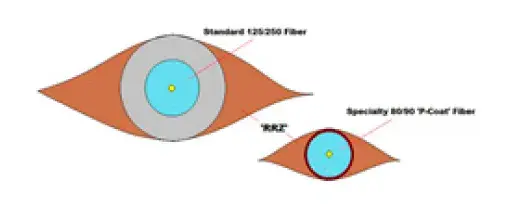
Although currently deployed primarily in Civil Engineering, the field of Structural Health Monitoring using embedded optical fibers has also been applied to the composite materials used in aircraftiv. The problem with using embedded optical fiber is that they are usually at least 10X the diameter of the typical, 10µm glass or aramid reinforcing fibers that give the composite its high strength. The result is that the presence of the fiber within the composite effectively creates an un-reinforced void within the material that contains primarily resin, known as a Resin Rich Zone (RRZ).
Graphic Comparison of the ‘RRZ’
Created by Standard and ‘Specialty’ Fibers
The presence of these RRZs weakens the composite, but the magnitude of this weakening may be reduced by using low profile fibers, particularly when combined with a suitable, low profile coating. The first graph on the right illustrates an extreme case in which the sensing fibers are laid perpendicular to the reinforcing fibers. Thereby maximising the area/volume of the RRZ, and comparing the RRZ created by a conventional 125/250 fiber with that of a 80/90 fiber with a special, low-profile Polyimide coating only five microns thick.
Strain Properties
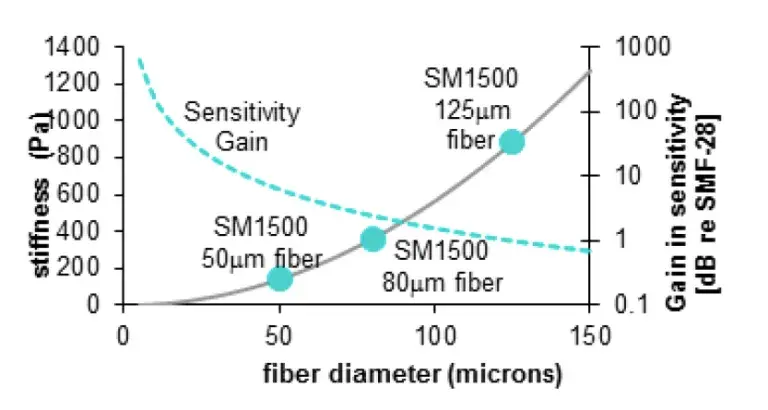
Low profile fibers also offer significant performance advantages in any sensor or component that operates via a strain mechanism for the simple reason that it takes less force to stretch a thinner fiber.
Improvements in Sensitivity due to Low Profile Fibers
- 60% and 84% less for 80μm and 125μm fibers, respectively. This benefit extends to piezo-electric modulators and also to fiber hydrophones, in which the modulation of the sensor mandrel, induced by the acoustic wave modulates strain induced in the fiber. The first graph to the right shows the sensitivity gain achievable in a fiber hydrophone with different diameter fibers.
Reliability / Lifetime
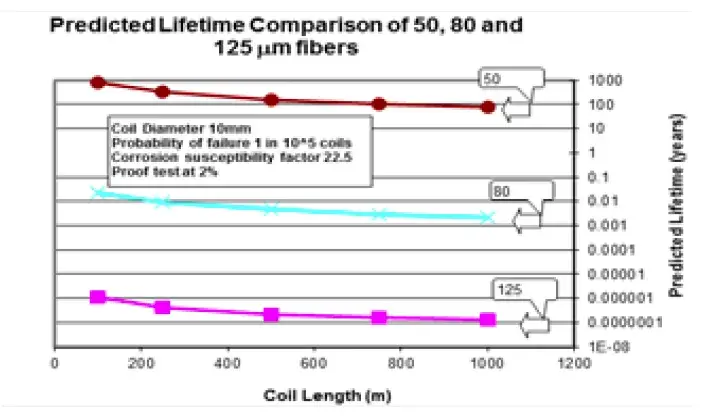
Many sensors demand that fibers are coiled to diameters far smaller than any encountered in conventional, telecoms applications. This is sometimes as small as 10mm, compared with (say) the 60mm minimum indicated in most CCITT and Telcordia documents. Installed fibers fail in service by the phenomenon of static fatiguev, where fracture is triggered by the growth of intrinsic micro-flaws present on the glass surface. Reducing the fiber diameter reduces bend-induced strain proportionately with a commensurate increase in service lifetime. Lifetimes may be increased even further by screening out larger micro-flaws by the process of ‘Proof Testing’, stretching the fiber to failure during manufacture by 1% (telecoms standard) – 3%, thereby leaving progressively smaller micro-flaws present on the fiber surface, and guaranteein correspondingly higher breaking strength. In the 10mm coils used in some sensors, the specification of a 3% proof test over 1% can make the difference between a service life of 25+ years and a few weeks (see graph). Increasing proof test levels also makes fibers less likely to break during general handling, assembly and cabling processes, even if they are not used in small-diameter coils.
Conclusion
Far from being the fragile material of reputation, silica is actually stronger than high-tensile steel and when designed and deployed in the appropriate way, ‘Low Profile’ Optical fibers can not only enhance the performance and increase the usability of new sensors and sensor networks, but can both enhance the strength of ‘Smart’ composites and outlast their thicker, conventional counterparts.
References
i ‘The fiber optic gyroscope’, H.Lefevre, Artech house 1993, ISBN 0-89006-537-3
ii ‘The Effect of the Earth’s Rotation on the Velocity of light’, A.A.Michelson & H.G.Gale, Astrophysical Journal, Vol 61, p.140 (1925)
iii ‘Large-Scale, Remotely Interrogated Arrays of Fiberoptic Interferometric Sensors for Underwater Acoustic Applications’, G.A. Cranch, P.J.Nash and C.K.Kirkendell, IEEE Sensors Journal, Vol.31, February 2003
iv ‘Overview of Fiber Optic Smart Structures for Aerospace Applications’, Eric Udd SPIE doi:10.1117/12.948881
v ‘Strength and fatigue of Silica optical Fibers’, C.R.Kurkjian, J.T.Krause and M.J.Matthewson, Journal of Lightwave Technology, Vol.7, Issue 9, September 1989
Download Full White Paper
Complete the form below to download the white paper.