
The rapid growth of artificial intelligence (AI), machine learning, and high-performance computing (HPC) is placing unprecedented demands on data center infrastructure. As GPU and network processor ASIC bandwidths increase and system power density continues to rise, traditional electrical and optical interconnect architectures are approaching current technology limits.
Co-Packaged Optics (CPO) has emerged as a promising architectural response to these challenges. By integrating optical engines closer to, or directly alongside, AI processors, CPO improves energy efficiency and bandwidth density.
While much of the discussion around CPO focuses on integrated optics design choices, its implications extend well beyond the chip. As optics move closer to processors, new fibers and new fiber attach methods are employed.
This article explores what co-packaged optics is, how it differs from traditional approaches, and, crucially, what CPO means for fiber design, selection, and integration as optical systems continue to evolve.
What is Co-Packaged Optics?
Co-Packaged Optics refers to an architectural approach in which integrated optical engines containing, modulators and photodetectors, are adjacent to or integrated into the same package as a switch ASIC or processor. This contrasts with conventional pluggable optics, where optical transceivers sit at the front panel and connect to the processor via high-speed electrical traces.
By dramatically shortening electrical interconnect distances, CPO helps address several growing challenges in modern data centers:
- Power consumption by eliminating electrical physical layer ICs
- Package density and thermal management
- Physical constraints on electrical chip edge, aka, shoreline density
CPO is part of a broader continuum of optical integration approaches, which begins with Linear Pluggable Optics (LPO), and evolves to near-package optics (NPO). Co-packaged optics is the next evolution in environments where density and energy efficiency are critical.

How CPO Changes Optical Interconnect Design
The primary benefit of co-packaged optics lies in eliminating the chips required to transport signals from processors to optical transceivers electrical distance. The figure of merit for power consumption is power per bit, normally 1-50 pJ/b.
However, this architectural change introduces new system-level constraints:
- Optical engines operate closer to high-power silicon, increasing thermal exposure
- Packaging density increases, leaving less room for fiber routing and strain relief
- Assembly tolerances tighten with smaller integrated optic waveguides
- Manufacturing repeatability and product reliability are more critical as port counts scale
These factors have a direct impact on how fiber is selected, routed, and integrated. While the electrical portion of the interconnect is shortened, the optical portion becomes more demanding, particularly within compact, high-density packages.
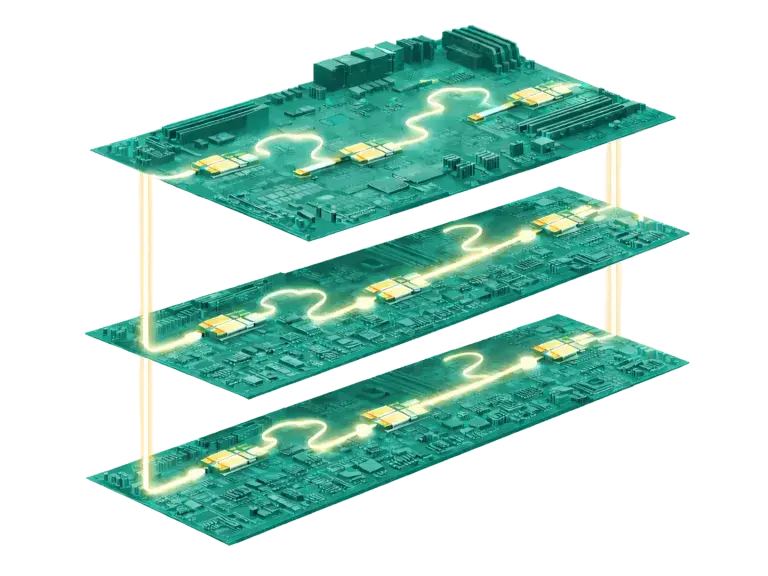
Example of optical interconnect.
The Role of Fiber in Co-Packaged Optics
CPO changes where and how fiber is used, while increasing the performance demands placed upon it.
Even in CPO architectures, fiber continues to play several essential roles:
- Connecting optical engines to external networks
- External polarized optical power delivery to integrated optics
- Supporting longer-reach links beyond the package or rack
- Matching or converting mode fields from integrated optics to SMF
- Amplifying long reach optics for datacenter interconnect
As optical engines move closer to silicon, fiber interfaces operate under tighter optical, thermal, and mechanical constraints. This places greater emphasis on fiber consistency, stability, and integration compatibility.
Subscribe for Insights!
Register to receive Fibercore's latest key updates, events and relevant industry news
straight to your inbox!
Bridge Fiber and Mode-Field Conversion in CPO
One of the most significant optical challenges introduced by co-packaged optics is mode-field mismatch. Integrated photonic devices often exhibit mode sizes that differ substantially from standard single-mode fiber, making efficient coupling more difficult as packaging density increases.
Bridge fibers are commonly used to address this challenge by easing spot-size or mode-field conversion between photonic devices and external fiber. In high-density CPO environments, effective mode-field conversion improves coupling efficiency resulting in:
- Reduce insertion loss
- Increase output power or reduce input power
- Increase assembly yield
- Tighten overall link budgets
- Reduce need for spot size converters on photonic die
As margins shrink, the ability to control mode-field characteristics becomes a key enabler for scalable photonic integration. Fiber is no longer a passive afterthought, but an active element in optical system design.
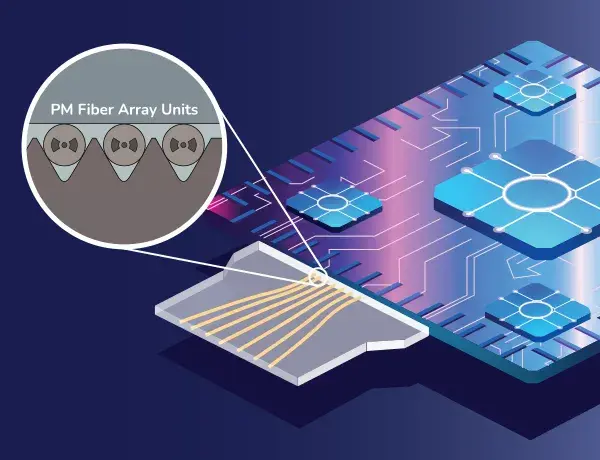
Optical Power Delivery Fiber in Co-Packaged Architectures
Polarisation control is another area where CPO architectures increase demands on fiber performance.
Polarisation-maintaining (PM) or high-birefringence (Hi-Bi) fibers are used in:
- Power delivery fiber to grating couplers into CPO chips
- Fiber array units (FAUs) into the edge of CPO chips
- Coherent and Multi-Level (PAM4) modulator inputs: most modulators prefer one singular linear polarization state.
In co-packaged environments, PM fibers must operate reliably under:
- Elevated temperatures
- Steep thermal gradients
- Tight bend radii
- Mechanical stress from compact routing
Tight-bend PM fibers are particularly valuable in dense assemblies, where space constraints limit routing options.
Long Reach Links: Why CPO Does Note Eliminate Distance
While co-packaged optics perform well within a data center, adding amplification enables additional connections:

Data center to Data center interconnect

Campus-scale connectivity

General internet connectivity
For links exceeding one kilometer, fiber performance remains a critical differentiator regardless of whether optics are pluggable or co-packaged. Fibercore’s High Absorbtion Reduced Clad (HARC) fiber continues to provide signal gain for longer link lengths with in very small packages such as OSFP or QSFP.
Packaging Density, Thermal Constraints and Fiber Stability
CPO places fiber interfaces closer to some of the most thermally active components in the system. Proximity to high-power processors introduces challenges that traditional front-panel optics rarely encounter.
Key optical fiber considerations include:
- Thermal stability of fiber performance
- Resistance to mechanical stress
- Consistent performance under tight bend conditions
- Long-term reliability in compact assemblies
As optical systems scale to millions of optical interconnects within one AI cluster, reliability becomes just as important as peak performance. Fibers used in CPO-adjacent environments must deliver stable behaviour across large volumes and extended operating lifetimes. Fibercore offers high temperature acrylate coating rated to 150C operation.
Ribbon Fiber and the Shift Toward Multicore
Increasing bandwidth density is driving innovation not only in photonic devices, but also in fiber geometry. Traditional ribbon fibers have long supported parallel optical architectures, but rising density requirements are prompting exploration of multicore alternatives.
Multicore fibers offer the potential to:
- Increase spatial density
- Reduce cable bulk
- Simplify routing in constrained environments
While adoption remains application-dependent, this trend reflects a broader shift toward fiber as a strategic design element, rather than a standard commodity component. MSAs are only beginning to form.

Where Fibercore Supports the CPO Ecosystem
Co-packaged optics is not a single product category, but an evolving ecosystem spanning integrated photonics, packaging, and connectivity. Within this ecosystem, Fibercore participates as a pure fiber specialist, supporting multiple enabling roles.
Bridge Fiber for Mode-Filed Optimisation
Fibers designed to ease mode-field conversion help improve coupling efficiency and manufacturing yield in compact photonic assemblies.
HI-BI AND PM FIBER FOR CPO POWER DELIVERY AND FAUS
High-birefringence and tight-bend PM fibers support stable polarisation performance in dense, thermally demanding environments.
HARC FIBER FOR EXTENDED-REACH LINKS
For applications exceeding one kilometre, HARC fiber was designed specifically for integration into optic modules. HARC remains essential, regardless of whether optics are pluggable or co-packaged.
As an independent fiber manufacturer, Fibercore is not vertically integrated into switching or silicon platforms. This independence allows collaboration across the photonics ecosystem without competing directly with system vendors — an important consideration as CPO architectures mature.
MULTICORE FIBER FAUS
For new MSA and custom applications, Fibercore’s multicore fibers allow for higher density.
HIGH TEMPERATURE ACRYLATE COATED FIBERS
High temperature fiber coatings allow for reliable 150C operation.
The Future of Co-Packaged Optics and Fiber Integration
Co-packaged optics represents an important step in the ongoing evolution of optical interconnects, particularly for AI-driven and high-performance systems. Adoption is likely to be faster than past ecosystem evolutions, though near-package and linear optics modules will preceed full co-packaged approaches in the near term.
Rather than reducing the role of fiber, CPO requires fibers to perform more tasks with places greater emphasis on its reliability, performance, consistency, and integration compatibility. Fiber remains a foundational technology — enabling the next generation of photonic architectures as systems continue to scale.
READ MORE
Explore more of our expert insights—click below to discover related articles that dive into fiber optic technologies and their real-world applications.



Speak to our experts
Provide us with your information and our service team will contact you

Richard Manderscheid
Richard brings over 20 years of experience in sales and engineering within the fiber optic and telecommunications sector. His wealth of expertise in fostering client relationships and his proven track record of exceeding sales targets, makes Richard a valuable asset to Fibercore. Prior to joining Fibercore, Richard held a senior sales position at LUNA Innovations, where he was responsible for managing channel for both instruments and optic components.